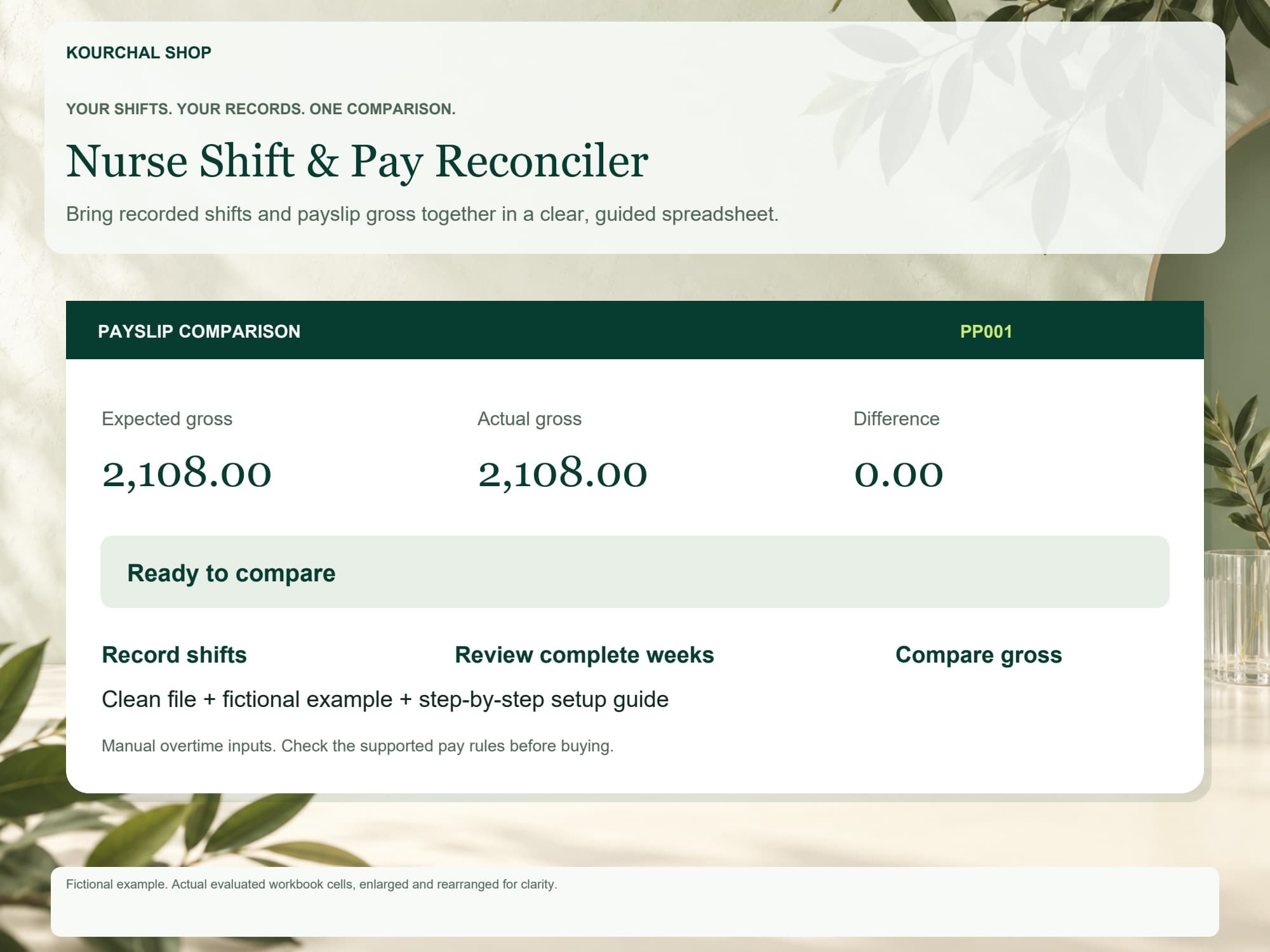
A quick way to review a CNA paycheck is to compare the pay-period dates, recorded shift time, applicable rates and gross pay before deductions. Keep each employer workweek separate. A difference is a prompt to ask payroll for an explanation, not proof of an error.
1. Match the pay-period dates
Start and end dates on the pay statement may cover more than one workweek. Write down each shift date and the employer’s fixed workweek separately. Under the U.S. Fair Labor Standards Act, the workweek is a recurring seven-day period and hours generally cannot be averaged across two workweeks when calculating federal overtime. Check your employer’s workweek dates rather than assuming they match the calendar week.
2. Reconcile each shift
For each shift, compare your own start and end times with the timekeeping record you are permitted to access. Then check the break entry and any correction, missed punch or approved adjustment. Do not automatically subtract a scheduled break from your notes: whether a meal period counts as work time depends on the facts and applicable rules. A bona fide meal period generally is not work time when the worker is relieved from duty; interrupted or on-duty breaks may be treated differently.
Use the records and reporting process your workplace requires. Do not put patient names, room numbers, medical details, passwords or access codes into a personal tracking sheet.
3. Compare hours and pay components
Separate regular hours, overtime hours, shift differentials and other pay lines instead of combining them into one number. Compare gross earnings before taxes and deductions. Take-home pay is lower after items such as tax withholding and benefit deductions, so it is not a like-for-like comparison with a gross-pay estimate.
Simple fictional example: 36 recorded hours at a $20 regular hourly rate equals $720 in base gross pay before other pay components or deductions. This example does not decide which breaks count, whether overtime is owed, or how a particular differential must be treated.
4. Ask a focused payroll question
If something does not match, note the exact pay-period date, shift date, time entry or pay line, and the explanation you need. For example: “Could you help me understand how the March 4 shift and its break entry appear in this pay-period total?” Keep the discussion factual and use your employer’s payroll process. If you need a legal answer, contact an appropriate labor authority or qualified adviser.
Can a spreadsheet prove that my paycheck is wrong?
No. A personal tracker can organize recorded shifts and flag a number to review, but it cannot determine your legal status, interpret every employer policy, or establish that wages are owed. Federal and state rules, exemptions, employer workweeks and pay components can affect the calculation.
A simple way to organize the comparison
The Nurse Shift & Pay Reconciler lets you record shifts, breaks and rates, then compare a supported gross-pay estimate with a payslip. It is designed for one employer and one currency, using a supported U.S. standard weekly regular-rate calculation. It does not decide overtime eligibility, handle daily or 8-and-80 overtime rules, calculate taxes or take-home pay, or include every bonus, leave, on-call or payroll component.
Preview the actual two-page workbook example (PDF)
See the Nurse Shift & Pay Reconciler
Sources and limits
This guide is general organization information for U.S. hourly workers, not legal, tax or payroll advice. Follow current workplace procedures and applicable rules. The Department of Labor’s fact sheets summarize federal FLSA requirements; state or local protections may differ.
U.S. Department of Labor: Overtime Pay Requirements (Fact Sheet 23)